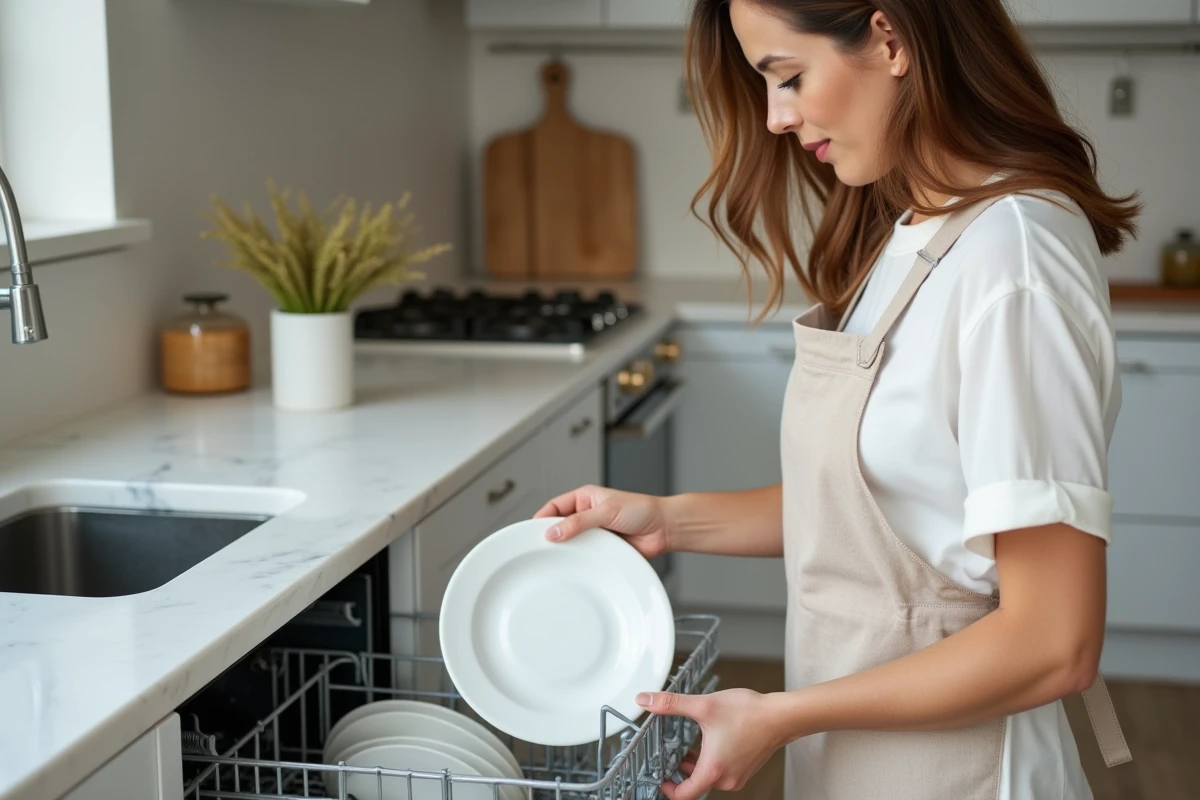
Does porcelain go in the dishwasher without damage? The answer depends less on the material itself than on what covers it. Plain white porcelain and porcelain with hand-painted gold decorations do not react the same way to automatic washing cycles. Understanding these differences allows for an informed choice, piece by piece.
White, decorated, or gilded porcelain: dishwasher resistance compared
Not all porcelain is equal when it comes to a washing cycle. The determining factor is not the hardness of the ceramic paste, but the nature of the finishes applied to the surface.
| Type of porcelain | Dishwasher compatibility | Main risk |
|---|---|---|
| Plain white porcelain (without decoration) | Compatible for daily use | Surface micro-scratches over time |
| Porcelain with under-glaze decorations (patterns integrated during firing) | Occasional to daily compatible | Low risk, decoration is protected by glaze |
| Porcelain with painted decorations on glaze | Occasional use only compatible | Progressive fading of pigments |
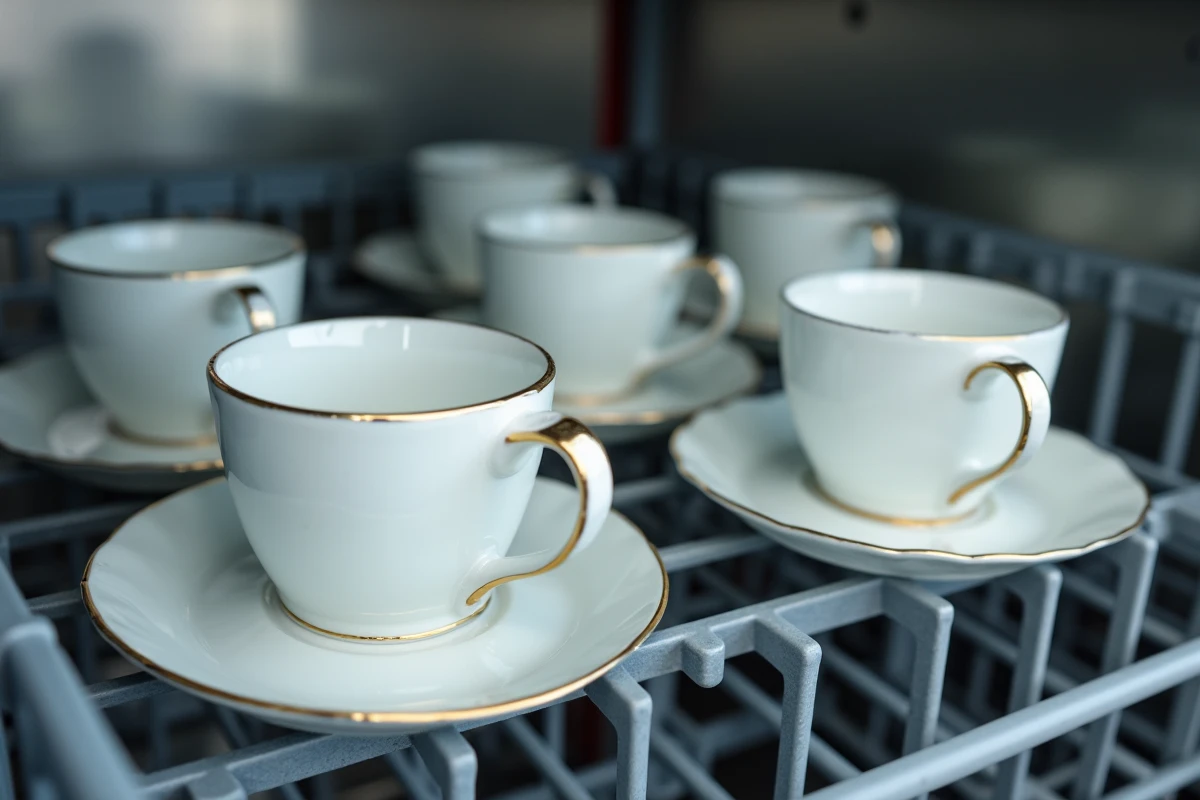
| Porcelain with gilding or metallic fillets | Not recommended | Wearing away of gilding due to chemical and mechanical abrasion |
| Antique or collectible porcelain | Hand washing recommended | Micro-cracks, loss of heritage value |
Several brands like Rosenthal and Villeroy & Boch now differentiate in their notices “occasionally dishwasher compatible” and “daily dishwasher compatible”. This distinction, which has emerged in recent years, reflects a change in approach: compatibility is no longer binary.
The question of porcelain and dishwashers arises piece by piece, depending on the type of decoration and the intended washing frequency.
Detergents and washing programs: what really damages porcelain
The dishwasher does not harm porcelain solely through heat. Two combined factors cause wear: the pressure of water jets and the alkalinity of detergents.
Chemical agents involved
Conventional detergents contain powerful alkaline agents designed to dissolve cooked fats. These compounds gradually attack surface decorations, especially gilding and painted glazes.
Manufacturers like Finish (Quantum Glass Protect range) or Somat (Glass & Silver Protection formulas) have developed products with low alkaline content, marketed as better suited for decorated porcelain. Their effectiveness on fats remains slightly lower than that of standard detergents.
Dedicated porcelain programs
Some high-end dishwashers include specific programs. Miele (G7000 series) and Bosch (Glass & China program) offer cycles with reduced jet pressure and lower temperature. These settings limit mechanical abrasion on fragile pieces.
- The recommended washing temperature for decorated porcelain is well below standard intensive cycles, which can far exceed the comfort threshold for fragile glazes.
- Reduced jet pressure decreases the risk of impact between pieces, a common cause of chips on plate edges.
- Low-temperature drying avoids thermal shocks that can weaken old glazes.
Without a dedicated program, the eco cycle is preferable to the intensive cycle for porcelain, as it combines moderate temperature and extended duration.
Everyday porcelain in catering: professionals’ practices
Feedback from the CHR sector (cafés, hotels, restaurants) provides concrete insights. High-end establishments that use porcelain daily have developed distinct practices depending on the type of dishware.
The trend observed among restaurateurs is to reserve the dishwasher for white or minimally decorated porcelain, while maintaining hand washing for pieces with metallic or painted decorations. This separation is not a whim: it responds to a finding of accelerated wear on decorated pieces washed in machines multiple times a day.
For domestic use, the washing frequency is much lower. A decorated porcelain piece washed in the machine once or twice a week will undergo significantly less degradation than in a professional context. However, daily use in the dishwasher over several years will eventually visibly alter surface decorations.

Loading precautions: avoiding mechanical breakage in the dishwasher
The most common damages to porcelain in the dishwasher are not chemical but mechanical. Chips, cracks, and micro-cracks result from contact between pieces during the cycle.
- Space each plate and cup to avoid any direct contact. Porcelains should never touch or be stacked in the basket.
- Place cups and bowls upside down in the upper basket, tilting slightly to allow water to drain.
- Do not mix porcelain with heavy items (pots, pans) in the same cycle: vibrations transmitted by massive objects increase the risk of impact.
- Remove pieces immediately after the cycle ends rather than leaving them in residual moisture, which can dull glazes over time.
These precautions apply to all fine ceramics, but they become particularly crucial for collectible pieces or antique services, where a single chip can significantly reduce the value of the whole.
Plain white porcelain handles daily dishwasher use very well. For pieces with painted or gilded decorations, hand washing remains the only guarantee for long-term preservation. Between these two extremes, choosing an appropriate program, a low-alkaline detergent, and careful loading can reduce risks without giving up the machine.