
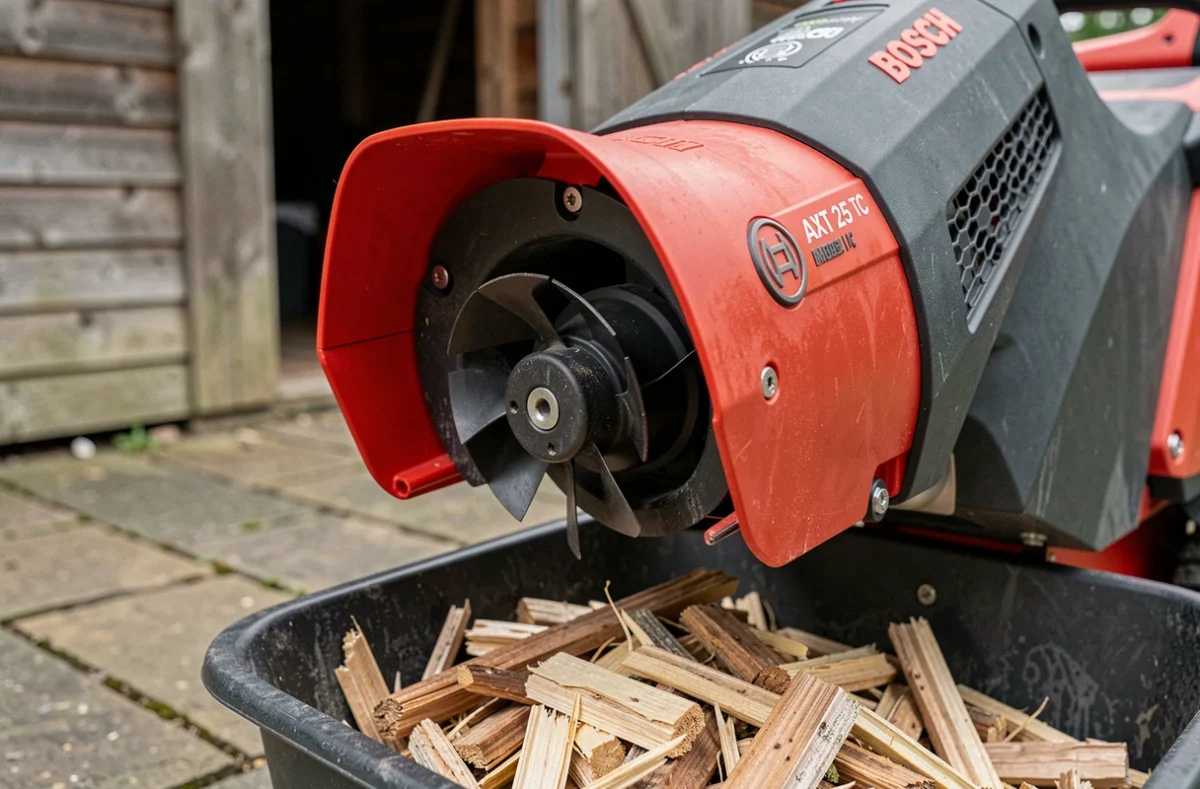
The Bosch AXT 25 TC is based on a turbine cutting system (Turbine Cut) that clearly distinguishes it from the knife rotor shredders in the same Bosch range. We observe that this design difference conditions everything else: throughput, particle size of the mulch, performance with wet vegetation, and long-term maintenance.
Turbine Cut system with wet leaves: the true limits of the Bosch AXT 25 TC
The Turbine Cut system excels with dry and semi-woody branches. The turbine sucks in the vegetation, compresses it, and cuts it into fine fragments, producing mulch that can be used for mulching or as wood chip mulch (BRF).
With soft and wet green waste, the situation changes. Wet leaves, sappy perennial trimmings, and grass clippings form fibrous clumps that clog the cutting chamber. The reverse function, intended to clear jams, is less effective against these soft bundles: it frees a stuck branch but not a compressed material plug. Manual cleaning remains necessary after switching off and completely disconnecting the device.
We recommend that gardens producing mainly wet leaves alternate with a pass of a mulching mower or allow the vegetation to dry for one to two days before shredding. Systematically mixing dry branches with soft waste also helps the turbine maintain its suction flow.
Cutting capacity and wood hardness: what the 45 mm limit really means
The technical specifications indicate a maximum cutting diameter of 45 mm. This figure corresponds to soft or semi-hard wood branches (thuja, laurel, privet). With denser species like oak, dogwood, or hawthorn, the turbine struggles well before reaching this diameter. The mechanical effort increases, the 2,500 W motor heats up, and jams multiply.
In practice, we find that it is better to aim for a diameter of 35 mm for hard woods to preserve the longevity of the mechanism. Forcing the device on sections that are too thick prematurely wears out the turbine and activates the thermal protection, interrupting work sessions.
For a garden composed of hard-wooded shrubs, the Bosch AXT 25 TC shredder remains relevant as long as branches are pre-sorted by diameter and the largest sections are reserved for a thermal tool.
Regular maintenance and spare parts for the Bosch AXT 25 TC shredder
The maintenance of this shredder is not limited to sharpening. Several points require regular attention to maintain performance over time.
- The power cable should be inspected at friction points, as gradual damage to the sheath creates an electrical risk often overlooked in tests focused on shredding throughput.
- The turbine accumulates sticky residues (sap, leaf pulp) that reduce suction efficiency. Cleaning after each extended session prevents chronic clogging.
- The 53-liter bin sometimes cracks under UV exposure after several seasons. Storing it in a sheltered place prolongs its lifespan.
Specific spare parts are documented and available from specialized retailers, allowing for targeted repairs (replacement of the turbine, pusher, bin) rather than a complete replacement of the device. This is a tangible advantage compared to some competing models whose parts are no longer referenced after a few years.
Maintenance frequency according to usage
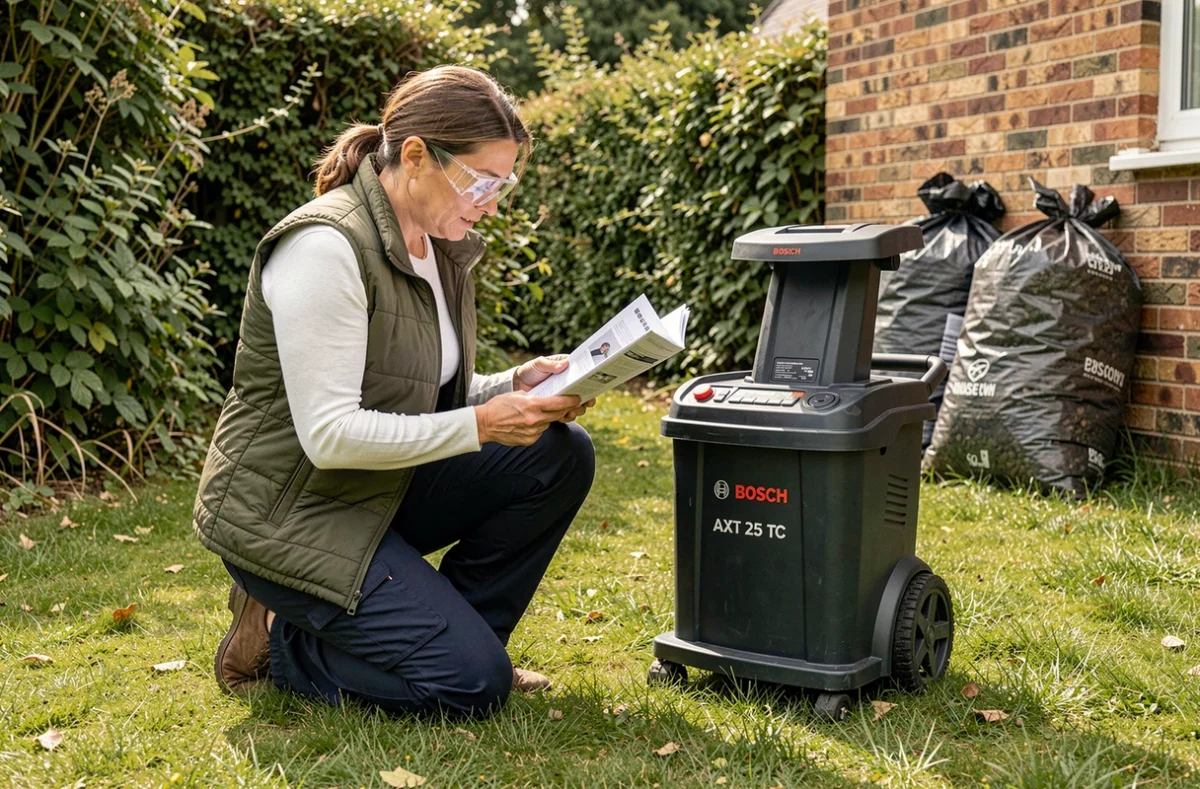
For monthly use in a medium-sized garden, cleaning the cutting chamber every three sessions is sufficient. Intensive weekly use (hedges, orchard) requires checking the turbine and cable at each session. Preventive maintenance directly affects the lifespan of the Turbine Cut mechanism.
Noise level and ergonomics in real conditions
The Turbine Cut system generates less noise than a conventional blade shredder. This difference is particularly noticeable in residential areas, where long shredding sessions become tolerable for neighbors.
However, the weight of the device is a drawback. Moving it on soft or sloped terrain requires real effort, and the wheels do not fully compensate for the mass. This shredder is better suited for a fixed position than for mobile use in a large garden.
The loading funnel accommodates straight branches well. Forked twigs or clumps of trimming must be recut before introduction, or immediate clogging will occur. The provided pusher helps guide the vegetation, but it does not replace careful pre-sorting.
Comparison with the knife rotor system
The Bosch rotor models (AXT 22 D, AXT 25 D) use a different mechanism: a rotating plate equipped with knives that cut by impact. This system tolerates soft and wet vegetation better but produces coarser mulch and generates more noise. The choice between turbine and rotor thus directly depends on the composition of the garden’s green waste.
A mixed garden (evergreen hedges, deciduous shrubs, flower beds) makes the best use of the turbine. A garden dominated by wet broadleaf trees and herbaceous trimmings will find the rotor more versatile for daily use.
The Bosch AXT 25 TC remains a high-end electric shredder designed for dry and semi-woody wood. Its turbine, availability of spare parts, and moderate noise level make it a durable investment for regular use. However, it does not forgive approximation: pre-sorting branches, avoiding wet clumps, and maintaining the cable as well as the cutting chamber condition long-term satisfaction.